
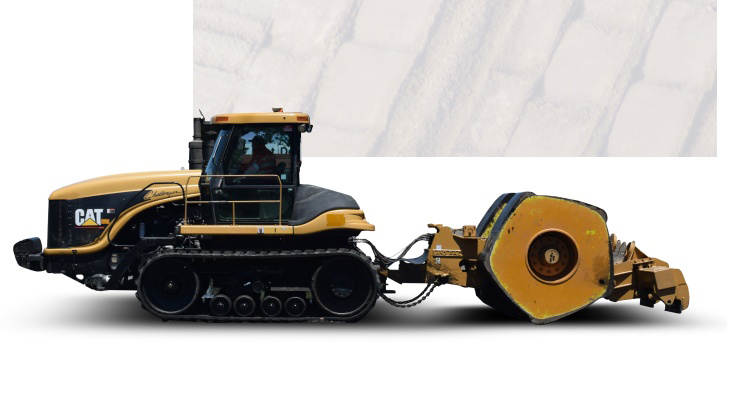
In architecture and building, in-situ material refers to materials that are pre-existing on the construction site. Applying High Enery Impact Compaction (HEIC) to in-situ materials reduces site downtime and costs as materials do not need to be removed or substituted.
With the use of Intelligent Compaction Measurement (ICM) technology, deep impact compaction techniques developed by Dynamic Compaction solutions can compact saturated and unsaturated, loose and very lose sands to a dense and very dense state to a 10-foot depth and a medium density to 16-foot depth.
HEIC enhances the stability and strength of the soil, crucial for varying soil conditions. This provides consistent, uniform compaction across heterogeneous sites, resulting in improved load-bearing capacity and minimised costs.
Unmanaged coal waste poses significant environmental and safety risks, from pollution to land instability. Discover how HEIC offers a solution, enhancing waste management and fostering a safer, more sustainable mining environment.
Compaction reduces the voids present in soil hence permeability also reduces. At a particular density, for the same soil sample, permeability is more for soils which are compacted to dry of optimum than those compacted to wet of optimum.
Proof rolling (also known as ‘test rolling’) examines the mass response of subgrade to vehicle-type loads before pavement layers are constructed. This practice is performed by driving a selected heavy vehicle over designated areas of the soil surface.
HEIC ensures enhanced stability, uniformity, and load-bearing capacity, overcoming the challenges traditionally associated with compacting thick fills and contributing to more robust and reliable construction outcomes.
The removal or alteration of existing structures often necessitates concrete breaking and demolition. These critical tasks demand reliable and efficient methods. High Energy Impact Compaction (HEIC) presents a robust solution for concrete breaking.
Old age landfills which are often used for recreational purposes can be treated with impact compaction to reduce creep settlement and maintenance costs. If adverse soil conditions pose potential risk to people or the environment, HEIC allows compaction without the need to unearth or disturb what’s underneath.
In general, compacted granular soils will have higher dry densities in the range of 115 to 135 lb/ft3 (1.84 to 2.16 g/cm3) than those of clayey to silty soils, which are in the range of 85 to 115 lb/ft3 (1.36 to 1.84 g/cm3).
Compaction involves rearranging soil particles into tighter configuration, increasing soil density. This increases the shear strength and liquification resistance of the soil, encouraging a dilative response instead of a contractive dynamic soil response.