The Crucial Role of High Energy Impact Compaction in Permeability Reduction
One of the most significant challenges in geotechnical engineering is managing the permeability of soils. Permeability is a measure of the soil’s ability to transmit water or other fluids. Highly permeable soils can lead to a variety of issues, such as weakening of the soil structure, instability due to excessive seepage, and difficulties in achieving desired compaction levels. High Energy Impact Compaction (HEIC) can play a pivotal role in managing these challenges by effectively reducing soil permeability.
Understanding Soil Permeability
Soil permeability is governed by the size and connectivity of the pores or voids within the soil matrix. Coarse-grained soils, like sands and gravels, usually have high permeability due to large and well-connected voids, while fine-grained soils, like clays and silts, have low permeability due to small, less connected voids.
Permeability, in scientific terms, refers to the ability of a porous material (in this case, soil) to allow fluids (like water or air) to pass through it. This term originates from the field of fluid dynamics and is extensively used in earth science and civil engineering.
Permeability reduction pertains to the process of decreasing the rate at which fluid can move through a porous material. This is achieved by altering the size, shape, or connectivity of the pores within the material. In soil mechanics, permeability is governed by factors such as grain size distribution, the shape of particles, the degree of saturation, and the density of the soil. Larger, more interconnected pores in the soil result in higher permeability, whereas smaller, less interconnected pores result in lower permeability.
High Energy Impact Compaction and Permeability Reduction
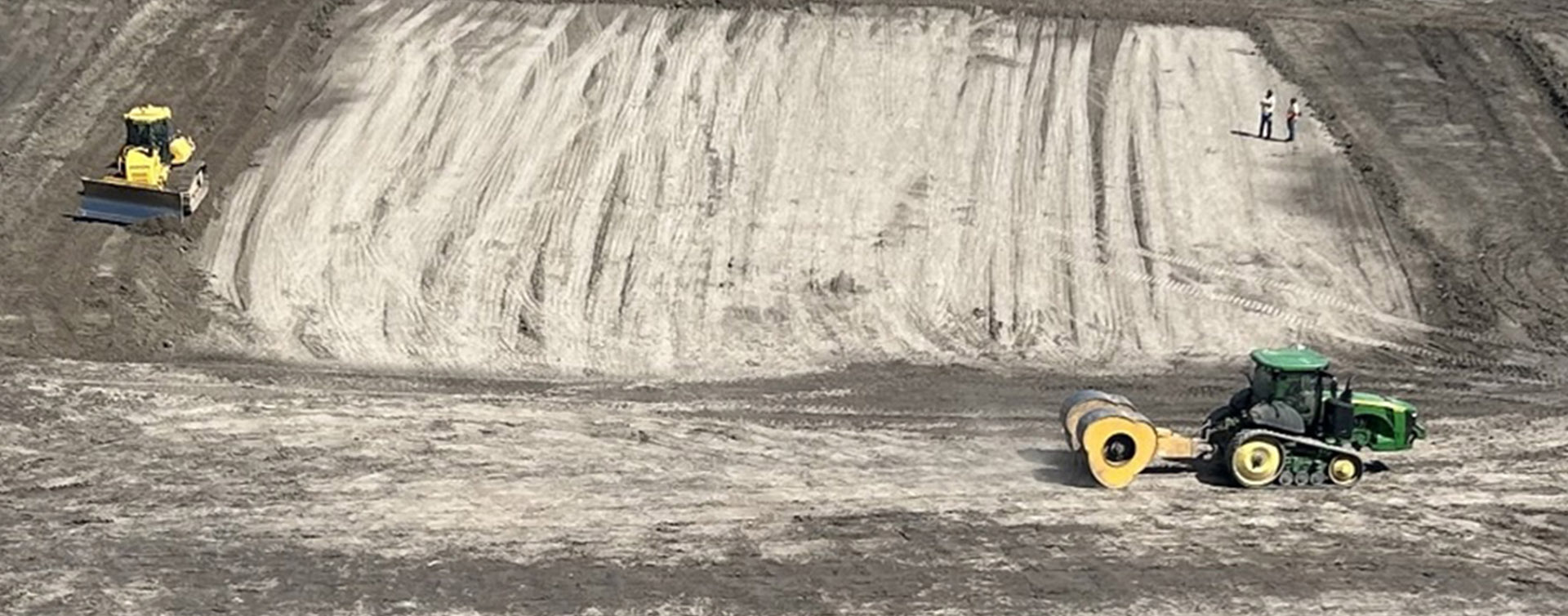
High Energy Impact Compaction (HEIC) is a ground improvement method that delivers high compaction energy to the soil surface, resulting in deep and uniform compaction. The compaction process rearranges the soil particles, reducing the size and connectivity of the voids. This rearrangement decreases the soil’s permeability, as fewer interconnected pathways exist for water to flow through.
Technical Aspects of Permeability Reduction with HEIC
Particle Rearrangement: The high compaction energy in HEIC results in a more tightly packed soil structure. It effectively rearranges the soil particles, closing off voids and making it harder for water to penetrate.
Density Increase: HEIC increases the soil’s density, effectively reducing the pore spaces between soil particles and hence lowering the permeability.
Depth of Influence: One of the advantages of HEIC is the depth to which it can effectively compact soil. This deeper compaction leads to a more significant reduction in permeability throughout the treated layer.
Sustainability: By reducing permeability, HEIC limits excessive water infiltration into the soil, thus maintaining its shear strength and reducing the risk of soil liquefaction in seismically active areas.
Versatility: HEIC can be used on a wide variety of soil types, making it a versatile tool for managing permeability in different geological contexts.
Measuring Permeability Reduction
From a scientific standpoint, permeability reduction through HEIC can be quantified and measured using various methods, including in-situ tests like the falling head permeability test or the constant head permeability test, or laboratory tests such as the triaxial permeability test. These tests provide data that help engineers understand the soil’s hydraulic conductivity, a measurable representation of soil permeability, before and after the application of HEIC, thus confirming the degree of permeability reduction achieved.
Benefits of Permeability Reduction in Civil Engineering Projects
Reducing soil permeability is often a desirable outcome in civil engineering projects, particularly when it’s necessary to limit the amount of water infiltrating the soil, such as in dam construction, landfill sites, roadbed construction, and foundations for buildings. HEIC provides a powerful tool for addressing permeability-related challenges, ensuring long-term durability and performance of the ground structures.
The Role of Dynamic Compaction Solutions
By using HEIC, engineers at Dynamic Compaction Solutions are able to effectively control and reduce soil permeability, creating safer, more stable conditions for construction and other ground improvement applications. This technique provides a powerful tool for addressing permeability-related challenges, ensuring long-term durability and performance of the ground structures.
For more information on how HEIC can benefit your project, get in touch with Dynamic Compaction Solutions today.